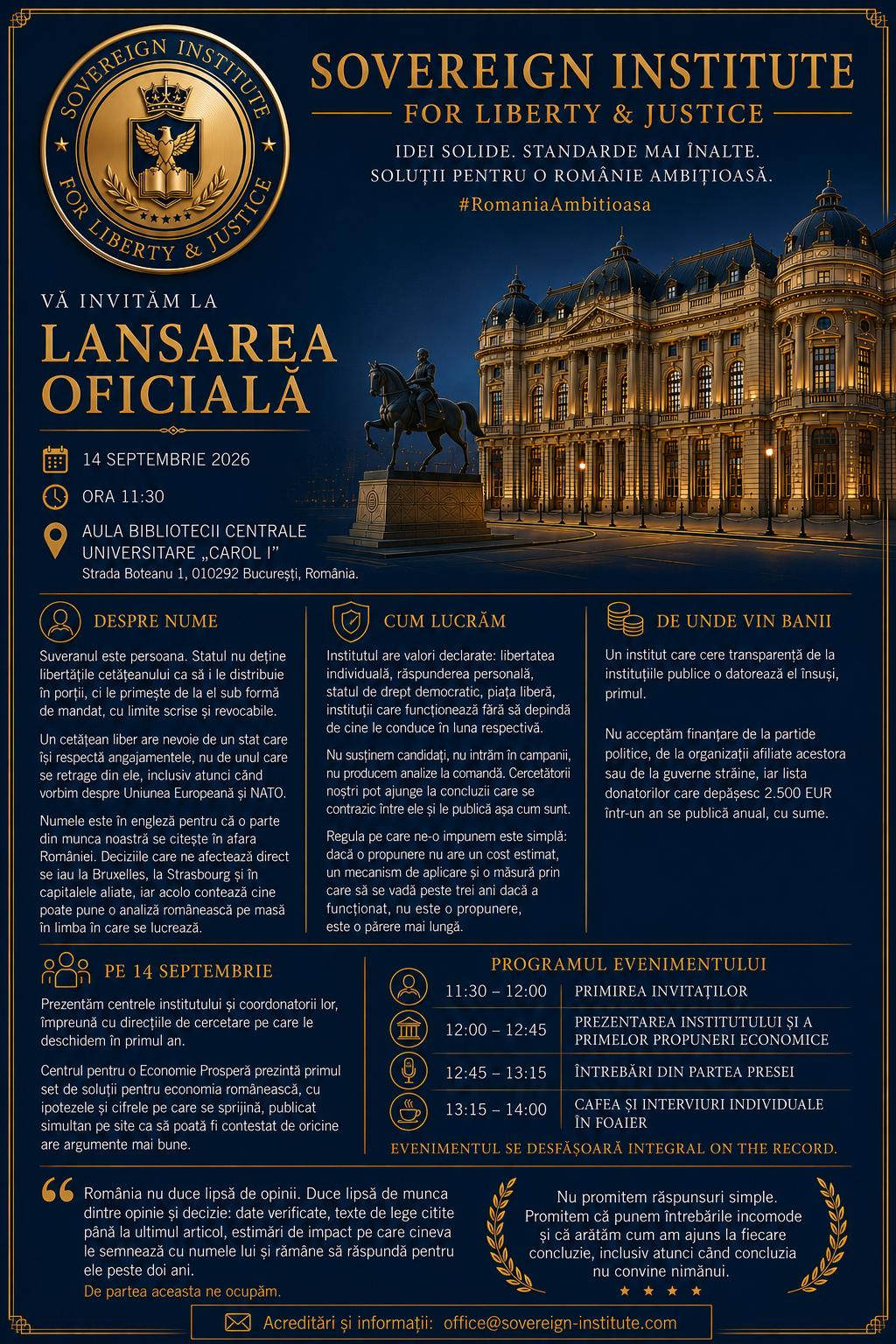
Monday, 14 September 2026 · 11:30
Official Launch of Sovereign Institute for Liberty & Justice
Aula of the Central University Library “Carol I”, Bucharest
About the Name
Sovereignty belongs to the person, and the state exercises its authority within the limits of the legal mandate it receives from citizens. Fundamental rights and freedoms are not concessions of the state, nor benefits it can grant or withdraw at discretion. Guaranteeing and protecting them represents obligations of the state, which condition the legitimacy of the exercise of power.
The state is not the holder of the citizen’s freedom, but the guarantor of its exercise. This function requires not only formal compliance with the law, but also ensuring legal certainty: clear and predictable norms, institutional stability, coherence in the exercise of authority, and protection of the legitimate trust the person may have in the continuity and consistency of the state’s conduct. Citizens cannot be asked to organise their lives, professional activity, or legal relations within a framework that the state modifies unpredictably or applies contradictorily.
A free citizen therefore needs a predictable state — one that respects its own norms, the commitments it has assumed, and the legitimate expectations its conduct has created. The same requirement applies to Romania’s membership in the European Union and NATO: not as a circumstantial option, but as an expression of legal and institutional continuity that strengthens legal certainty, trust in the democratic order, and the stability of the framework in which rights and freedoms can be effectively exercised.
The English name expresses the European and international vocation of the institute. A significant part of the norms, standards, and public policy orientations relevant to Romania take shape in European institutions, in Strasbourg, and within allied structures. Real participation in these processes requires the capacity to produce research that is comparable, intelligible, and usable in the professional space where these ideas circulate and are evaluated.
We aim for the analysis produced in Romania to enter the European circuit of research and public policy debate — to be read, discussed, and cited by institutes, universities, experts, and decision-makers from other states. The goal is not only external visibility, but the capacity to integrate the Romanian perspective in shaping agendas, evaluating options, and building decisions that directly concern Romania.
How We Work
The Institute starts from a few explicitly declared values: individual freedom, personal accountability, the democratic rule of law, a free and competitive market, and institutions solid enough to function independently of whoever temporarily leads them. We state them publicly because transparency about one’s own premises is part of research rigour. The reader must know where we begin and be able to evaluate what we publish accordingly.
Independence does not mean the absence of values, but the absence of orders. The Institute does not endorse candidates, does not participate in campaigns, and does not produce pre-set conclusions to serve political or institutional interests. Researchers may reach different and even contradictory results. We publish them as such, when methodology and data support them.
Every analysis must be verifiable. The author, method, sources, and relevant data are identifiable, and conclusions must be reconstructable and contestable. When we are wrong, we correct explicitly. The credibility of research does not stem from the claim of infallibility, but from the willingness to expose one’s own reasoning to verification and revision.
The same rule applies to public policy recommendations. A proposal that does not indicate anticipated effects, costs, an implementation mechanism, and criteria by which it can subsequently be evaluated remains an opinion, not a well-founded solution. Research begins where a claim can be verified and continues until results can be measured.
Freedom of expression is a fundamental premise of democratic society, but its effective exercise requires more than formal legal recognition. It depends on the existence of an educational, institutional, and informational framework that favours the autonomous and informed formation of opinions, through access to credible sources, transparency, and the development of critical thinking.
In Romania, one of the vulnerabilities of the public space concerns precisely the insufficient consolidation of these conditions. In the absence of critical thinking, information can be selected and interpreted according to interests, pre-existing beliefs, or group affiliations, and disagreement risks being transformed from an instrument of deliberation into a reason for intolerance, labelling, and stigmatisation.
The relevance of an opinion for public debate does not derive from the status of the person who formulates it, but from the quality of the reasoning process: verifying data, critically evaluating sources, examining alternative perspectives, and rigorously analysing the normative framework.
It is in this space that the institute aims to operate: between information, knowledge, and decision. Through independent and interdisciplinary research, evidence-based analysis, and conclusions open to examination and revision, its goal is to contribute to a more rigorous, more tolerant, and better-founded public debate.
What Happens on September 14
We present the institute’s centres and their coordinators, together with the research directions we are opening in the first year.
The Centre for a Prosperous Economy for Romania presents the first set of solutions for the Romanian economy, with the hypotheses and figures on which they rest. The full material is available to event participants at the start of the event and is published simultaneously here, on the site, so that it can be contested by anyone with better arguments.
Why Now
The political cycle favours immediate reaction and often compresses the time needed for long-term analysis. Under these conditions, public policies may be formulated under the pressure of urgency, applied for extended periods, and abandoned without a rigorous evaluation of effects, costs, or the relationship between declared objectives and results actually obtained.
A research institute must operate within a different temporal and methodological horizon. Its role is to identify vulnerabilities before they become crises, to formulate hypotheses, to build alternative scenarios, and to test the possible consequences of different intervention options. This requires difficult and even uncomfortable questions: what is the real problem a policy is trying to solve, what data demonstrates its existence and scale, what causal relationships can be sustained, what alternatives exist, what are the direct and indirect costs, who bears them, what unintended effects may arise, and by what indicators can the success or failure of the intervention subsequently be evaluated.
We do not promise simple answers to complex problems. We do, however, commit to the discipline of formulating critical questions, making explicit the premises and limits of the analysis, and showing the methodological path that leads to each conclusion — including when results contradict initial hypotheses, dominant interests, or the conclusions someone would have preferred to reach.
Event programme
The event is conducted entirely on the record.